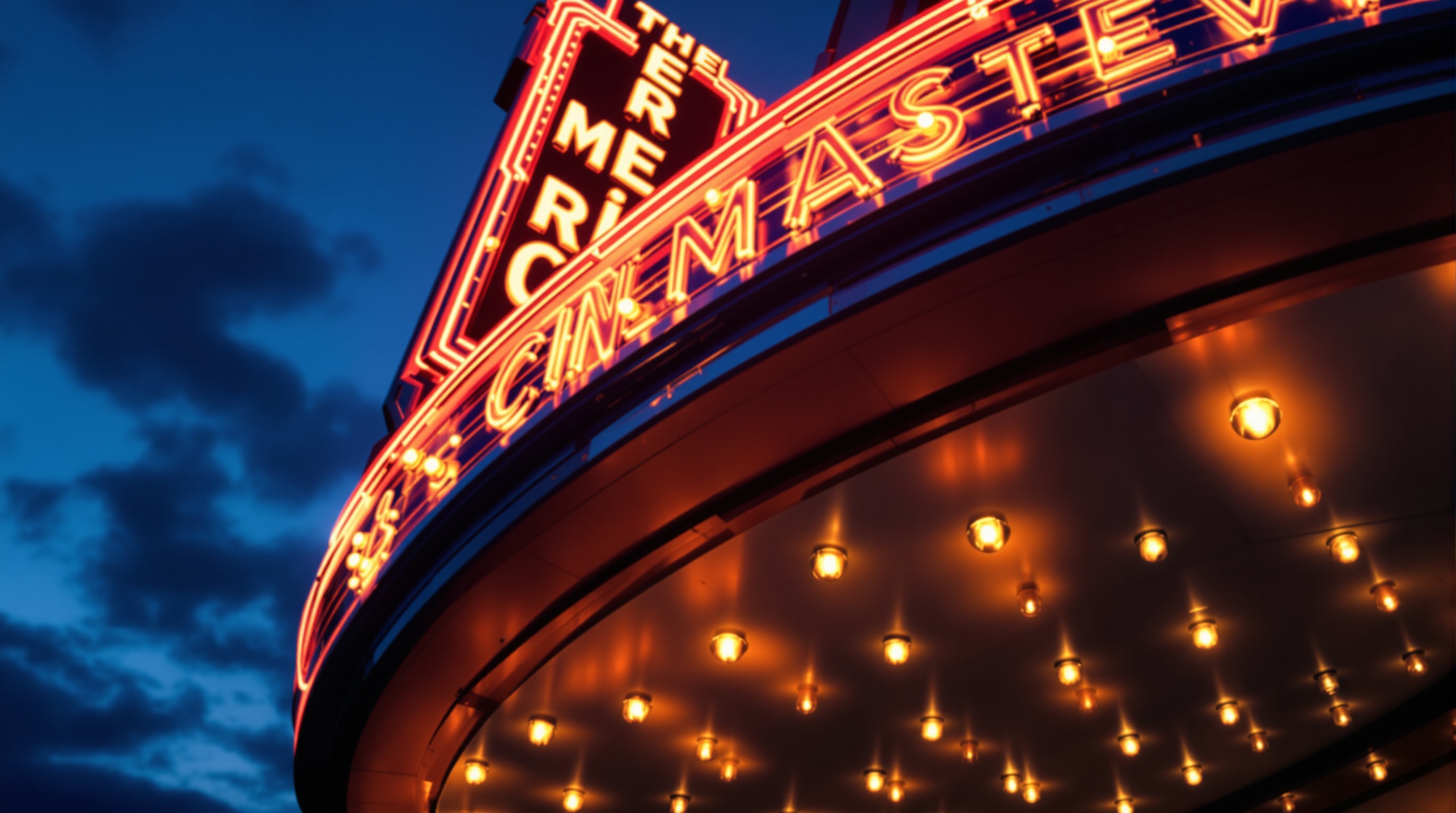
The Building and Its Marquee
A great theater begins at the sidewalk. Long before the lights went down, the Clover announced itself with a vertical marquee that turned an ordinary downtown block into a destination — a piece of mid-century optimism rendered in neon and steel.
Born in the Streamline Era
When the theater opened in 1950 it was designed in the Streamline Moderne style — a late, populist branch of Art Deco defined by smooth horizontal bands, rounded corners, and a sense of forward motion, as if the whole building were gliding toward the future. Contemporaries described the Clover's design as a modest, "budget-moderne" interpretation of the idiom: not a lavish movie palace, but a clean, confident small-town house that borrowed the glamour of the big city on a Main Street budget.
That was exactly the point. Across postwar America, thousands of towns got theaters like this one — buildings that used a bold marquee and a bright vertical blade sign to make a single-screen house feel like the center of the world on a Saturday night.
The Marquee as a Landmark
The marquee did more than list what was playing. It was a civic landmark, a meeting point, and the visual anchor of the downtown streetscape. Its cascade of bulbs and its neon glow drew the eye from blocks away and told everyone, without a word, that the town had a movie theater and that it was open for business.
It was this very marquee that, decades later, rescued the building. When a prospective buyer went looking online for a theater to restore, it was the Clover's mid-century marquee that caught their eye and sealed the decision. A sign built to sell tickets in 1950 ended up, more than sixty years on, selling the dream of the theater's revival. You can read that story in the theater's full history.
Why These Buildings Are Worth Saving
Historic theaters are among the most beloved and most endangered buildings in any American downtown. They are large, technically specialized, and expensive to maintain, which makes them vulnerable the moment ticket revenue falters. Yet they are also irreplaceable: their scale, craftsmanship, and marquees give a town its sense of place. The National Trust for Historic Preservation has repeatedly flagged neighborhood movie theaters as endangered resources, and preservation groups nationwide have made a specialty of rescuing them.
When a marquee goes dark, a downtown loses more than a business — it loses a landmark that took generations to earn its meaning. That is why archives, photographs, and preservation records matter, and why groups like the League of Historic American Theatres work to keep these buildings standing and in use. Learn how communities rescue historic theaters.